Black History Month does not have to feel like a separate celebration in your classroom or home. It is another powerful tool in the art box, one that helps children build voice, empathy, cultural awareness and confidence through making.
Two of the most accessible and meaningful ways to share Black history with young artists are through the works of Jean-Michel Basquiat and the Gee’s Bend Quilters’ tradition.
They show students that Black history is not only something to study but also something to create.
Basquiat: Teaching Kids That Their Voice Belongs on the Canvas
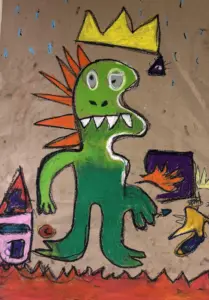 Basquiat’s artwork looks and feels like how many children already think, fast, layered, emotional and full of ideas. His paintings combine words, symbols, figures, and repeated marks to talk about identity, history, power, and culture.
In my classroom, Basquiat becomes a tool for helping students understand that:
- Their handwriting can be part of art
- Their feelings belong in their work
- Their personal stories matter
Try this simple activity at home
Ask students to create a symbol and word portrait:
- Choose three words that describe who you are.
- Add symbols that represent your family, interests, culture or dreams.
- Layer colors, shapes and lines without worrying about perfection.
Why this matters for Black History Month
Basquiat reminds students, especially Black and Brown students, that creative expression can be a form of leadership. His success broke barriers in a space that often excluded artists who looked like him. That message is powerful for young learners who are still discovering where they belong.
Gee’s Bend Quilts: Teaching History Through Community and Pattern
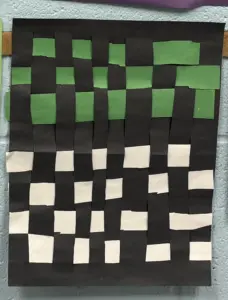 The quilts created by the Gee’s Bend Quilters come from a small Black community in Alabama. For generations, women stitched together worn clothing and leftover fabric to keep their families warm. Over time, these quilts became internationally recognized works of art.
What stands out to children right away is how bold and free the designs are:
- uneven shapes
- unexpected color combinations
- patterns that do not follow strict rules
Try this simple activity at home
Create a paper “community quilt”:
- Cut strips and rectangles from scrap paper or magazines.
- Arrange pieces freely.
- Ask the kids to name their quilt after something meaningful in their life, family, school, neighborhood or culture.
Why this matters for Black History Month
Gee’s Bend quilts show students that history is built through everyday life, through care, creativity, and collaboration. Children learn that art can come from what you already have, and that community stories are just as crucial as famous events.
Why Black History Belongs in the Art Box All Year Long
Basquiat teaches students about individual voice. Gee’s Bend quilts teach students about collective voice.
Together, they help children understand that art can:
- tell personal stories
- preserve family history
- reflect culture
- build confidence
In my own classroom, Black History Month becomes a reminder, not a requirement, that culturally rooted art experiences deepen learning for every student. When students create, they are not memorizing facts. They are learning how history connects to real people, real communities and genuine emotions.
A Simple Question That Builds Powerful Conversations
After students finish their artwork, I always ask:
“What part of your life did you put into this?”
That single question transforms art time into history time, reflection time and connection time.
Black History Month is not an extra box to check.
It is simply another tool in your art box and one that helps children learn how to see themselves, and each other, more clearly.
Kuwantu Cammon is an elementary visual art educator in Oklahoma who uses hands-on, culturally responsive artmaking to help children build confidence, creativity, and meaningful connections to history. The views expressed are his own and do not represent any school district.