
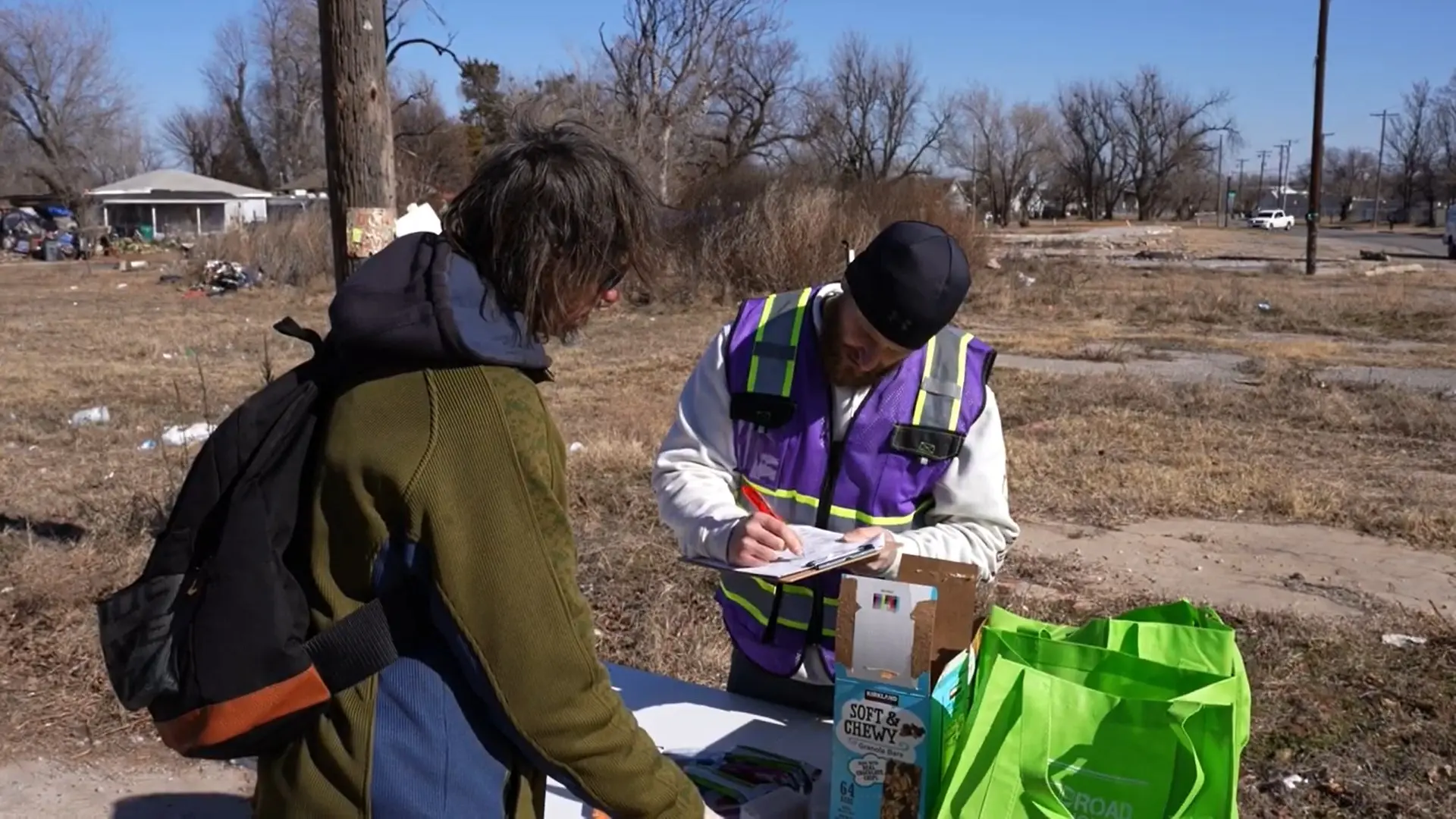
On any given night in Oklahoma City, more than 1,800 people are without stable housing — that might mean sleeping in shelters, transitional housing or outside. Each one represents a story, a struggle and a chance for change.
Homelessness is a complex issue that doesn’t look the same for everyone or every city. But behind every statistic is a neighbor. Someone from right here in our community. In fact, in the 2025 Point in Time survey, 75% of people experiencing homelessness said they became homeless in Oklahoma City, 87% in Oklahoma.
Thanks to the collaborative work of the City of Oklahoma City’s Key to Home partnership, many of our neighbors are finding a path to stability and self-sufficiency.
A collaborative approach to change
Key to Home serves as the lead agency guiding Oklahoma City’s homelessness response strategy and manages federal funds through the City’s partnership with the U.S. Department of Housing and Urban Development (HUD). The initiative unifies a variety of nonprofit organizations, city departments, foundations, schools and businesses.
“Key to Home is really an umbrella,” said Jamie Caves, strategy implementation manager for the initiative. “It’s the continuum of care to address homelessness in OKC, bringing together more than 50 partners, all pulling in the same direction.”
Caves said that the partnership’s success lies in the data-driven, supportive strategies and actionable directives implemented within the network. The unique approach is rooted in how stakeholders and providers work together and learn from one another.
“People in our community are really interested in looking at the data to identify where we can make the most impact,” she explained. “When working in tandem with our partners, we have created a constant feedback loop to improve our models, learning and adjusting as the work is being done.”
Caves said she is also working closely with representatives from other cities, including Tulsa and Dallas.
“Each community is addressing homelessness differently, but we are able to share lessons learned and success stories,” she shared.
3 core strategies for impact
Key to Home’s goals focus on three main areas:
1. Reducing inflow by providing early intervention. “Sometimes people just need a thought-partner, someone to help them through a crisis to help connect them to natural supports,” Caves explained.
In fact, 45% of people experiencing homelessness for the first time are able to self-resolve with minimal help, freeing up resources for those with higher needs. Caves said Key to Home has staff embedded at local shelters to serve as an initial support system.
2. Addressing long-term homelessness by removing compounding barriers. Key to Home’s Encampment Rehousing Initiative (ERI) has outreach teams that visit encampments to build trust and connect residents directly to housing options and support services.
“The longer you’re unhoused, the more obstacles stack up,” Caves said. “Our goal is to create exits from homelessness that fit each person’s needs.”
Through ERI, chronic and unsheltered homelessness has decreased by 43% over the past two years, 24 encampments have closed and 93% of encampment residents have accepted housing.
3. Expanding housing solutions using a variety of support options. “While some people need small, early intervention, others need long-term support and supportive housing,” said Caves. “We are working to stabilize and expand affordable housing options in our community.”
Their landlord engagement team has been a key factor in increasing the number of housing options available in the Oklahoma City area.
The numbers behind the mission
In Oklahoma City, during the most recent Point-in-Time count, there were 1,882 people experiencing homelessness, which included people in shelters, people sleeping outside and those in transitional housing. While the total number of people experiencing homelessness is up from 2024, several demographic groups decreased from last year. Of those 1,882:
• 433 were chronically homeless, a 9% decrease from last year
• 128 were veterans, a 6% decrease from last year
• 114 people were part of families experiencing homelessness, a 13% increase from last year
• 163 were unaccompanied youth, a 5% decrease from last year.
Real people, real results
Numbers are important — but so are the people impacted.
Caves shared about meeting a man who had been sleeping under a bridge despite holding a full-time job.
“He’d been evicted after falling behind on rent,” she explained. “He was the perfect candidate for early intervention.”
Another person Caves met recently lost his job after car repairs depleted his savings. Without a financial safety net, he became homeless.
“The longer you experience homelessness, a mountain of barriers piles up,” Caves said. “Without a car, he lost his job. Finding another job is really challenging without transportation.”
Key to Home partners connected these clients with housing and other resources.
The road ahead
By working together across more than 50 organizations, leveraging both public and private resources, Key to Home is making data-driven decisions that have produced a promising model to reduce homelessness in a coordinated, effective way.
In fact, Key to Home achieved its goal to provide housing for 500 unsheltered individuals by the end of 2025.
In 2026, efforts will focus on refining and expanding pilot programs, especially for early intervention strategies, Caves said. Another major emphasis will continue to be sustainable housing, ensuring there are affordable, reliable housing exits available.
“We are beginning conversations about what complex care might look like to create a more robust system for those that need a higher level of support,” Caves shared.
How you can help
Families interested in supporting Key to Home’s mission to prevent and end homelessness in Oklahoma City can help in a variety of ways. Donations help cover rehousing expenses such as furniture, deposits and application fees. Families can also help create move-in kits filled with essential supplies or donate gently used furniture. Tax-deductible donations can be made to a fiscal sponsorship fund at Communities Foundation of Oklahoma (CFO). Learn more at okc.gov.